soma(som)
Software with situated awareness.
An architecture for systems that work with people: six questions, one closed cycle, every cycle signed — and every step’s identity held by its predecessor.
§2 · The insight
No step proves itself. The predecessor closes the proof.
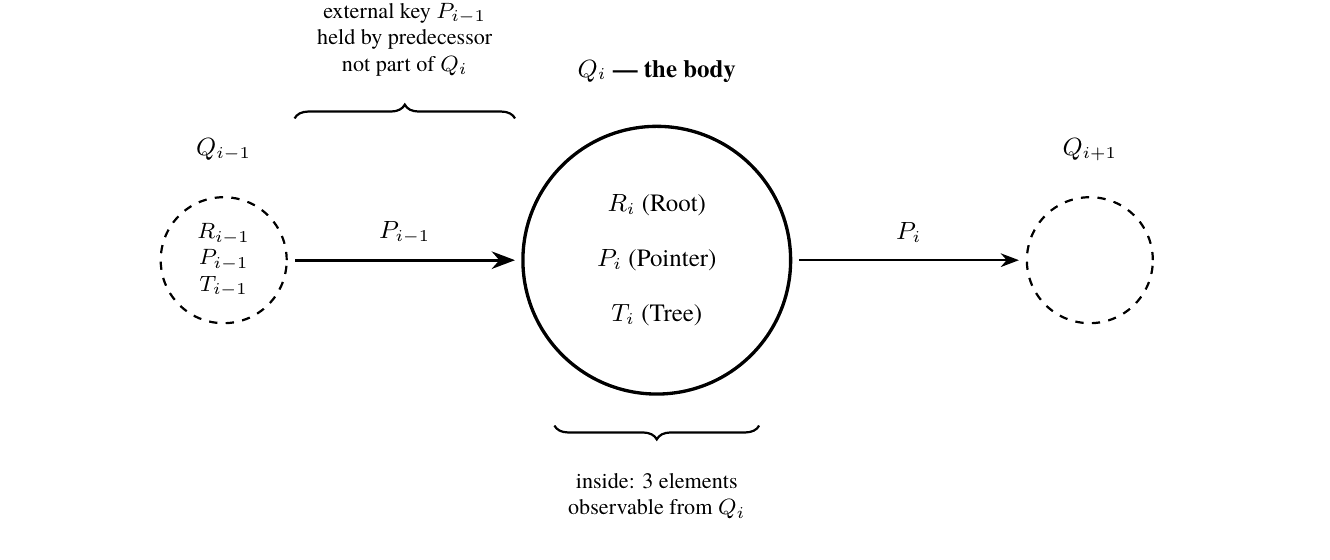
Inside any step on the ring, three elements of a Quad are visible: where you stand, what you’re focused on, what’s around you. The fourth element of the Quad — how your predecessor remembers you — exists outside. You can never hold your own external reference.
This isn’t a security policy — it’s the shape of the ring. In a directed cycle, every step takes its name from its predecessor. No step can forge itself, and no audit can be quietly rewritten from the inside.
You are who your predecessor says you are.
OPUS §2 · the body problem · Figure 1
§4 · The shape
Six questions. One closed cycle.
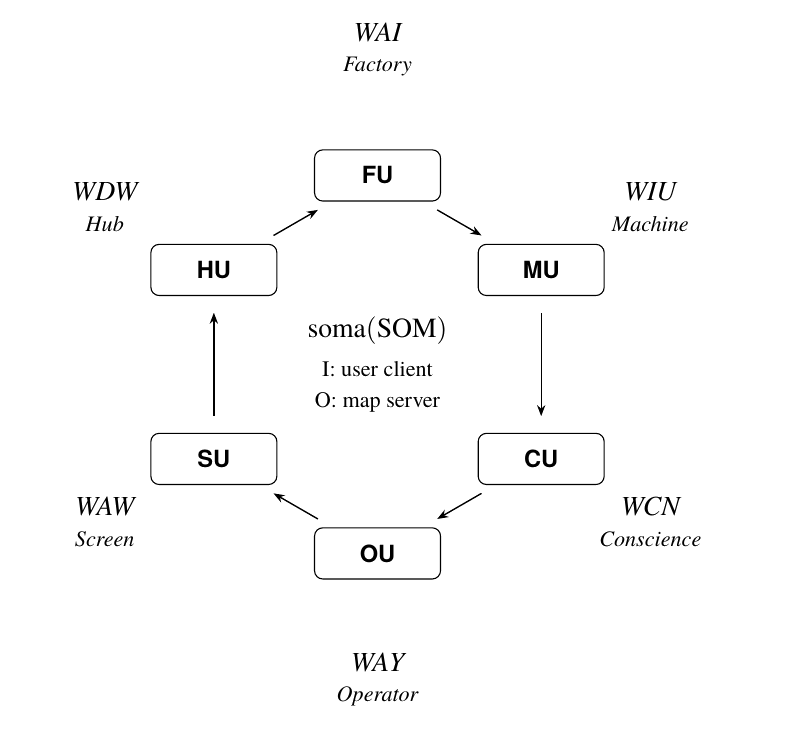
Every cycle asks the same six questions, in the same order — each one about the situation the machine shares with a person. When the sixth is answered, the cycle closes and the next begins where the last left off.
- FUWho am I?
- MUWhat is up?
- CUWhat comes next?
- OUWho are you?
- SUWhere are we?
- HUWhen do what?
Every cycle. Every question. In order. No shortcuts.
OPUS §4 · the SOMA ring · Figure 3
§9 · The chain
Every cycle signed. Every cycle holding its predecessor.
When a cycle closes, its state is sealed and embedded in its successor. The present holds its predecessor; the predecessor holds its own — all the way back to the start.
Change anything in the past and every cycle that came after stops verifying. You can walk the chain forward from the beginning, or backward from today — both directions agree on the same truth. The chain is the audit, and the audit is built in.
A memory is a past snapshot. Anticipation is a projected one. The chain holds both.
OPUS §9 · temporal SOM chain · Figure 6
