

01
What You Already Know
For any interested reader. If you have handed someone your ID, signed a document, approved a payment, or watched a system make a decision on your behalf, you already know most of this.
The Moment
You hand your passport across the counter. A clerk looks at the photo, looks at you, takes a beat, and hands it back. That beat carries the whole story of trust.
The clerk saw what was in front of them: a document, a face, the answer their lookup returned. They did not see what happened in the room behind them or in the immigration office in another city. They stood at their counter, and from that spot they verified what they could see.
This is how being somewhere works. It is not a limitation. It is the shape of every act of trust anyone has ever performed.
You have been in this same shape a thousand times.
- You show your ID at a hotel and the clerk checks it against the reservation.
- You sign a document and the notary stamps it.
- You approve a payment on your phone and the bank flags it against your usual pattern.
- You read an AI’s recommendation on a loan or a diagnosis and someone else decides whether to accept it.
In each of these, one person or one system stands somewhere, sees from there, and produces a trace of what they saw. The trace is what makes the moment auditable later. The moment is what makes the trace real.
soma(som) is what happens when a system is built on that shape from the beginning, instead of adding it on top afterwards.
Three Things You Always Know
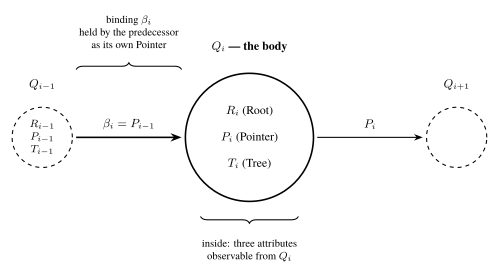
From wherever you stand, you always know three things:
- Where you are. Your position: the counter, the phone, the terminal.
- What is around you. Everything you can reach and see from that position.
- What has your attention. The one thing in focus right now.
Position, sphere, focus. That is your experience of any moment. Someone else, doing the same job at another counter, has their own three things. Same building. Different experience.
This is the ordinary structure of being somewhere. soma(som) takes it seriously — as the foundation, not as flavor. Everything the system does is a version of “someone standing at a position, seeing from there, producing a trace.”
Six Positions, One Cycle
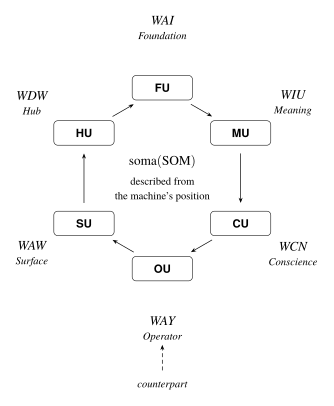
When a real act of trust plays out — approving that payment, signing that document, letting an AI act on your behalf — the same six questions get answered in the same order, every time.
- Who am I? — the position from which the act is happening; where the actor stands in this situation.
- What is up? — the situation, the request, the context.
- What comes next? — the anticipation, the policy, the permission being reasoned about.
- Who are you? — the other party being authenticated, and the moment the decision lands.
- Where are we? — the shared view, the record of the encounter.
- When do what? — the action, and the moment it took its place in history.
Six questions form a closed cycle. When the last one answers, the cycle closes and a new one begins from the first question. The system does not go back. It always moves forward. One cycle is one complete moment of trust.
Every act of trust that has ever been performed answered these six questions in some form, even if the person doing them never named them. soma(som) makes them explicit and enforces the order.
Two Things Happening at Once
Two things run inside every cycle, and they are very different from each other.
The first is the procedural body. The cycle always runs. The witnesses always stamp. The chain always extends. This part is certain. It does not depend on anyone being clever or paying attention. It is like your heart beating — it does not require your consent.
The second is the interactive soul. When the six questions get answered, something is produced that did not exist before. A permission. A signature. A shared understanding. That is not procedure. That is the encounter, and it is alive.
The body carries the soul forward. The soul gives the body meaning. Neither exists without the other. The whole architecture is called SOMA for the procedural body and SOM for the interactive state of mind. The two names together — soma(som) — record that both are always in play.
Like breathing. You never decide to breathe. But every breath produces the oxygen that lets you take the next one.
What Each Cycle Can See — And What It Cannot
Every cycle sees only what is inside that cycle.
This is not a security rule someone added. It is not information hiding. It is the shape of standing somewhere: from your position, you cannot see how a different position is referenced. The information does not exist where you are.
Think of a colleague’s memory of a meeting you both attended. It is not hidden from you. It just does not exist at your position — it exists at theirs. You have your own memory, built from where you stood. Neither of you has the other’s. Both are complete from their own side.
soma(som) treats this as the foundation of privacy and security. Because each cycle is scoped by position, several things happen naturally:
- Privacy. No global view exists. There is nothing to leak, because there is no vantage point from which the whole picture is visible.
- Security. If one cycle is compromised, that gives an attacker what was inside that cycle. It does not give them what belongs to any other cycle.
- Trust that has to come from outside. No cycle can verify itself. The moment must be witnessed by a position that does not belong to either side.
These properties are not features. They are what happens when the architecture respects that being somewhere means not being everywhere.
The Witnesses
Between every step of every cycle stands a witness. The witness belongs to the threshold, not to either side.
When something moves across a threshold, the witness signs a record of what crossed. Each signature includes a reference to the signature before it. The signatures chain, one to the next, all the way back to the very first one.
If anyone altered even a single record, every record after it would fail to match. Not because someone is guarding the chain — because the mathematics stops matching. Anyone can check the chain and find exactly where it broke.
This is what makes the past unforgeable. Not policy. Not procedure. Not vigilance. Geometry.

One Way In, Two Ways Out
There is exactly one way anything gets into a cycle, and there are exactly two ways anything comes out.
- In. A question or a command is placed at the first position. This is the only way anything enters — everything else the cycle does is a response to that placement.
- Out — the decision. Somewhere near the end, the “Who are you?” position produces a decision or a signature: what should happen, made under whose authority.
- Out — the shared view. In parallel, the “Where are we?” position composes the record that both parties can look at together: this is what happened, and this is what it looked like from where we stood.
Nothing bypasses the sequence. There is no side channel. No hidden write path. If the system produces an outcome, that outcome came through the two doors and can be traced to the one way in.
The Whole Ring’s Fingerprint
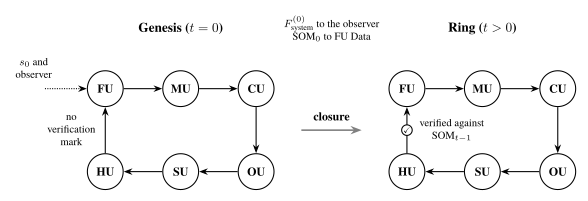
At the end of every cycle, the system computes one small piece of data: a digest that summarizes the state of every position at that moment. This digest — the ring’s fingerprint — depends on every attribute at every position, all at once.
If anything anywhere in the ring changes, the fingerprint changes. Two cycles with the same fingerprint are provably in the same state. Two cycles with different fingerprints differ somewhere in the ring, and the difference is what verification will find.
The fingerprint is what the chain of witnesses carries forward. Each new cycle’s chain includes the previous fingerprint. What is being chained is not just “an event happened” but “the whole system was in this state when the event happened.”
The First Cycle
If every cycle needs a cycle before it, how did the first cycle happen?
The same way a heart starts beating. The first beat has nothing to follow. A seed is placed. The first six questions are answered. The first witness signs the first record. Every cycle after this one chains to the one before.
The very first record — the genesis — becomes the anchor from which every later verification traces back. Trust does not require an external timestamping authority. It only requires the anchor and the chain.
What The Ring Knows — And What It Does Not
The system knows two things very well.
It knows its own shape: whether the cycles are running, whether the witnesses are at their posts, whether the chain is intact. Like the way your body reports that it is alive.
It knows the situation inside each cycle: the six questions are answered, and their answers are stamped and chained.
The system does not remember your name from last time. It does not learn. It does not adapt. It does not decide what is right. Those things happen where they should happen — in the interactive encounter, with the humans and other systems that participate in it. A system that is honest about what it cannot do is worth more than one that claims to do everything.
Extending Without Breaking
The cycles do not run alone. Extensions can join by standing in a defined relation to each cycle — before it, after it, around it, through it, or within it. Five relationships. Each extension sees from where it stands and never from everywhere.
When enough extensions gather, the cycles become something larger. Task management. Provenance tracking. Deployment. AI oversight. The whole thing running through the same cycles, producing the same chains — a system that keeps extending itself and improving itself through those same cycles. Each new deployment is one more link on the chain. Forward, always forward.
Cycles Inside Cycles
The last idea is the largest.
What if a cycle contained an entire cycle of cycles inside it? What if each of those inner cycles has its own six questions, its own witnesses, its own first genesis? The outer cycle would treat each inner cycle’s output the way the inner cycle treats a single act of trust: as something that entered from outside, was verified by the position it arrived at, and passed on to the next position.
If this composition holds, then organizations are cycles. Federations of organizations are cycles of cycles. The same shape works at every size.
Would the scoping still hold? Would one inner cycle be unable to see inside another, the way one cycle cannot see behind itself? The structural answer looks promising. The proof is still open, and this is honest.
If it works, it means the same simple truth — being somewhere means seeing from there — holds from the scale of a single act of trust to the scale of an entire industry.
What This Changes
We live in a world that asks us to trust. Trust the software. Trust the audit. Trust that someone verified. Trust that the AI had a human watching.
soma(som) is a system built so you do not have to.
The act of doing the work is the act of producing the evidence. Each act stands at a position, sees from there, and stamps a record that chains all the way back. Nobody can change the past. Anybody can check it. Not because someone built a better lock. Because that is what being somewhere already is, and has always been.
The system does not need trust.
The system produces trust.