

03
What the Ring Delivers
For executives, compliance officers, and heads of engineering deciding whether soma(som) belongs in their stack.
The Decision Behind This Document
At some point, every regulated organization realizes it is running two systems in parallel: one that does the work, and one that proves the work was done. Software engineering builds artifacts. Compliance departments assemble the evidence that those artifacts were built correctly. Audit teams verify the evidence. The costs are additive. The failure modes are additive. And the two systems drift out of alignment on the same schedule that any two independently maintained systems drift.
Every attempt to close the gap by better instrumentation, tighter workflows, or richer audit tables preserves the split. The instrumentation still runs beside the work. The evidence still describes the work rather than being the work.
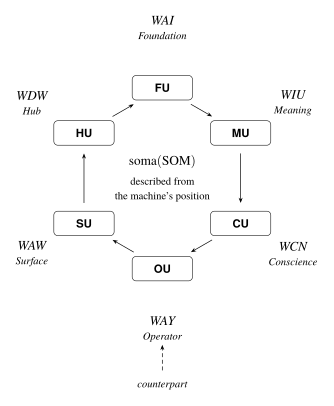
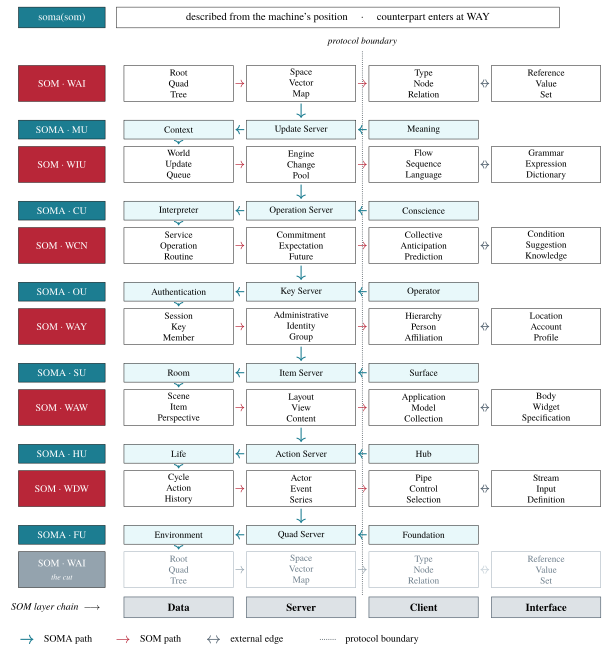
soma(som) is what happens when a system is designed so the two are the same act. The name splits the two dimensions that most systems have to run in parallel: SOMA is the procedural body — the ring, the chain, what runs whether anyone is watching. SOM is the interactive state of mind — what appears inside each cycle when perspectives meet. A regulated organization needs both, and soma(som) treats them as one.
The value below is what an organization gets when the proof stops being a separate process.
Compliance That Proves Itself
Traditional GRC platforms collect evidence about work that happened somewhere else. The tools that produce the work — CI pipelines, ticketing systems, code review platforms, deployment orchestrators — emit events, and the GRC layer stitches them together into a narrative that attempts to reconstruct what happened.
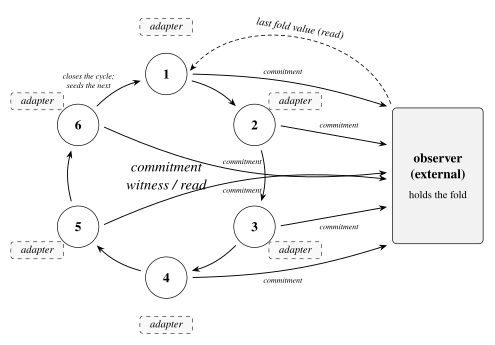
In soma(som), the ring is the work. Every action is a cycle. Every cycle generates witness stamps at every crossing. Every crossing has exactly one way in — a request placed at the first position — and every outcome comes out through exactly two positions: the decision, and the shared record of what happened. Nothing bypasses the sequence. The stamps chain backwards, all the way to genesis, each one carrying a fingerprint of the ring’s whole state at the moment of the stamp. Retroactive alteration of any single stamp breaks every stamp after it, and the break is detectable by forward verification in a single pass.
The intended audit posture requires no preparation: hand the auditor a verification key, they walk the chain, the chain is the audit. SOC 2, ISO 27001, FDA 21 CFR Part 11, ISO 13485 — these are the regimes the architecture is designed to answer with a single body of constitutive evidence, rather than evidence assembled retrospectively.
The intent: the organization does not run a separate compliance process. The organization runs the ring, and the ring is compliance.

AI Governance With Cryptographic Proof
Emerging AI governance frameworks — the EU AI Act, the NIST AI Risk Management Framework, US executive orders on AI safety — share one requirement: automated decisions must be traceable to human oversight, and the oversight must be demonstrable.
Demonstrable is the hard word. “We had a human review this” is not demonstrable. “This decision passed through an authorization gate that reduced its autonomy based on the caller’s role, the operation’s sensitivity, and the policy in effect at that moment, and the gate’s evaluation and its output authority level are both cryptographically stamped” is demonstrable.
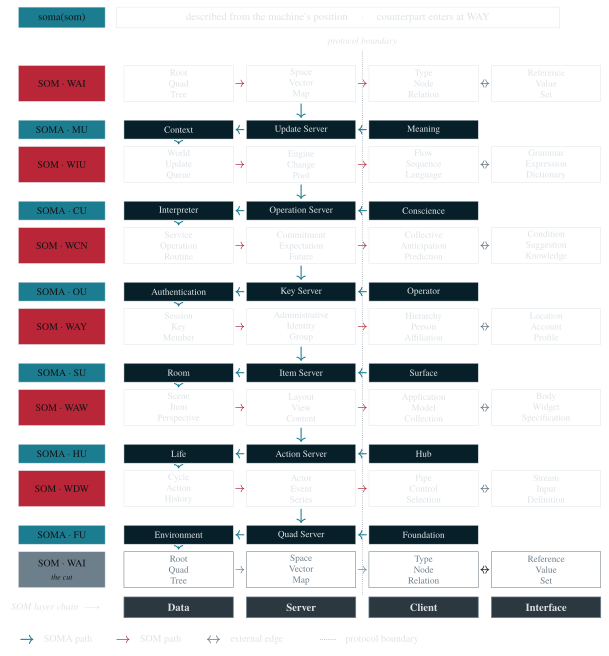
soma(som) is designed to provide the second kind. Every automated action passes through the Conscience Unit — CU — which evaluates the effective autonomy from the data the caller injected. The Operator Unit — OU — then attaches the identity boundary. The witness at OU stamps both the decision and the authority under which it was made. The stamp chains into the same ledger that carries every other cycle.
Provable human-in-the-loop is not a policy statement about a system. In this architecture, it is a property of every stamp the system produces.
Privacy As Natural Consequence
Data protection regimes — GDPR Article 25, HIPAA, sector-specific frameworks — increasingly require privacy-by-design and privacy-by-default. Most implementations satisfy the requirement through configuration: access control policies, data classification tables, anonymization pipelines, retention schedules. These are policy artifacts. They can be misconfigured. They can drift out of alignment with the code they govern. They are enforced by the same system they constrain.
soma(som) is designed to deliver privacy through geometry, not policy. Each processing unit sees only what is present at its position. The predecessor’s addressing key does not exist at the successor’s position — not because it is hidden, but because the topology does not carry it forward. The boundary strips it before signing the crossing record.
No global view exists to exfiltrate. No central identity store exists to breach. No permissions table can be misconfigured to reveal what the geometry never assembled. Cross-position correlation would require threshold cooperation between positions that hold complementary halves — administrative access to a single position yields only that position’s half.
GDPR Article 25 is not satisfied by a configuration setting. It is designed to be satisfied by the shape of the system.
Supply Chain Provenance With Temporal Ordering
Software supply chain integrity frameworks — SLSA, in-toto, SBOM regulations, EU CRA — increasingly demand not just what was built but who built it, under what authority, and in what sequence.
Every artifact that passes through the ring receives a witness stamp. Every stamp includes the previous stamp’s hash and a fingerprint of the ring’s whole state at the moment of the stamp. The chain therefore establishes not only that an artifact was produced but the full temporal order of the actions that produced it, the state of the system when each action happened, the authority under which each action ran, and the identity of the parties involved.
Timestamping is not a separate capability. It is an inherent property of the chain. External timestamping authorities are not required — the ring’s own genesis is the temporal anchor, and every cycle’s ordering is provable relative to it.
The provenance and integrity portions of SLSA Level 4 — the highest supply chain integrity level — are intended to be produced by the ring’s own operation. The build-system portions (hermetic environments, reproducible outputs) remain the responsibility of the build system itself; where those are addressed, the ring is designed to supply the attestation surface without a separate provenance layer.
Multi-Organization Federation
Cross-organizational verifiability is a hard problem. Blockchain solutions solve consensus among parties who do not trust each other, at the cost of consensus overhead that only makes sense when the parties do not interact continuously. Federated identity solutions solve authentication but not provenance. Zero-trust architectures solve access at the perimeter but not verifiability within.
soma(som) treats federation as ring-to-ring composition. Each organization maintains its own ring, its own chain, its own genesis. When two organizations need to collaborate with mutual verifiability, the crossing between their rings is witnessed by a boundary that belongs to neither. The witness stamps what crosses. Neither organization sees the other’s internal cycles. Both organizations can verify that the crossing they participated in did in fact happen, was authorized on both sides, and can be traced back through their respective chains.
Sovereignty preserved. Provenance shared. Trust produced, not assumed. Consensus not required, because there is no shared context that has to be agreed on — each organization’s ring is its own shared context.
What The Ring Is Not
To position soma(som) accurately, several adjacent categories need to be ruled out.
| Capability | soma(som) | GRC platforms | Blockchain | Zero Trust | SIEM / Observability | CI/CD |
|---|---|---|---|---|---|---|
| Proof model | Constitutive — work produces evidence | Retrospective — evidence collected after work | Consensus among untrusted strangers | Policy enforcement at access points | Event correlation after the fact | Attestation bolted onto artifacts |
| Privacy model | Topological — scoped by position | Role-based access control | Public or permissioned ledger | Micro-segmentation | Log aggregation with access controls | Secrets management |
| Trust assumption | None — trust is produced | Trust the platform | Trust the consensus | Trust the policy engine | Trust the log pipeline | Trust the pipeline config |
| Compliance posture | Always audit-ready | Periodic evidence collection | Immutable record, not governance | Access logs, not process proof | Detection, not prevention | Build provenance only |
| Scale model | Rings inside rings — composition validated at one scale; the full proof at meta-scale remains an open question the architecture bounds honestly | Hierarchical modules | Distributed consensus | Policy propagation | Horizontal log ingestion | Pipeline parallelism |
The blockchain comparison deserves emphasis. Blockchains solve consensus among parties who do not trust each other and may never interact again — the cost of consensus is worth paying when the alternative is no verification at all. The ring solves provable governance among actors who work together continuously but see from different positions. Blockchains need consensus because there is no shared context. The ring does not need consensus because each cycle is the shared context — scoped, witnessed, and chained. Different problems. Different costs. Different guarantees.
Current Substance
Today, soma(som) exists as an architectural specification — the OPUS paper — and a reference implementation under active development, open on Codeberg. The ring primitive is the first substrate to reach a tagged release: a Rust library for building the directed six-unit cycle, with the witness-chain and crossing attestation harnesses. Everything else described above is either expressed in the specification or being built against it.
Two deployment units are intended for public use once their substrate is sufficient:
- A verification engine. A single small container carrying the ring, the witness chain, and the cryptographic verification pipeline — designed to drop into an existing CI/CD pipeline and produce a verifiable chain for every artifact that passes through. No platform migration. No vendor lock-in.
- A trust-native composition. The engine plus the ring-native services the specification identifies — task management, code provenance, gate-based QA, AI orchestration, container deployment, security pipeline — each a solitaire with its own store, chaining through the same ring and producing the same self-verifying evidence.
Both deployment units are future tense. The architecture is specified; the ring is published; the rest is in build.
Where This Lands
These are the use-case contexts the architecture is designed for — the regimes whose evidence requirements map onto the ring’s native output. Treat them as the intended surface area, not as a list of adopters.
- Regulated software development. SOC 2, ISO 27001, FDA software validation, ISO 13485 — all demand evidence that the ring is designed to generate as a byproduct of normal work. The engine is designed to drop into existing pipelines and produce verifiable chains without changing what developers do.
- Financial services. Transaction provenance, audit trails, regulatory reporting. The intent is that MiFID II, Basel III, SOX compliance become properties of the workflow, not of a separate compliance function — every transaction carrying its own evidence, timestamped and chained.
- Healthcare. HIPAA and FDA 21 CFR Part 11 demand provable chain of custody and validated processes. The body problem is designed to deliver data isolation by architecture. The witness chain is designed to deliver process validation by construction.
- AI-intensive industries. The EU AI Act and adjacent frameworks require demonstrable human oversight and decision traceability. The Autonomy Equation evaluated at CU and witnessed at OU is the structural answer — not a governance layer on top of AI, but the structure through which AI operates.
- Defense and government. Classified segmentation, supply chain integrity (CMMC, NIST 800-171), and cross-agency federation with sovereignty preservation map directly to scoped rings, witness chains, and body-problem-native federation. The engine is designed to run air-gapped without external dependencies.
- Multi-organization consortia. Any arrangement where partners need to prove to each other what happened on their side of a boundary without exposing what happened inside their side. Ring-to-ring composition is the primitive the architecture offers here.
The Closing Position
soma(som) is not a better compliance tool. It is not a smarter audit platform. It is not a blockchain alternative. It is not a workflow engine with cryptography attached.
It is an architecture that reflects how trust actually works. You stand somewhere. You see from there. Every step leaves a mark that connects to every step before it. Anyone can check the marks. No one can forge them, because there is no vantage from which forgery could be committed.
The organization that adopts soma(som) is not adding another compliance layer to a stack. It is replacing the two-system model — work plus evidence collection — with a one-system model where the two are the same act.
The ring does not need trust.
The ring produces trust.